Services
Service Procedures/Standards
Service Standards are benchmarks or guidelines that include schemes, limitations, processes, and provisions that must be adhered to in the East Palapa Ring Project services.
Cooperation Scheme
This project uses a
Private Partnership (PPP) or
Government Cooperation with Business Entities (Kerjasama Pemerintah dengan Badan Usaha - KPBU) scheme. This scheme is regulated by
Presidential Regulation No. 38 of 2015 and aims to provide public services through collaboration between the government and the private sector.
Limitation
- East Palapa Ring only provides backbone services per project.
- Each project consists of a connecting city and a service city.
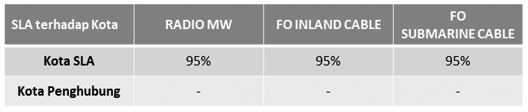
- The SLA is set at 95% and only applies to the Service City, not between cities.
- Customers are required to interconnect with at least 2 different NAPs (Network Access Providers) in the Connecting City to guarantee a 95% SLA in the Service City.
Process/Steps
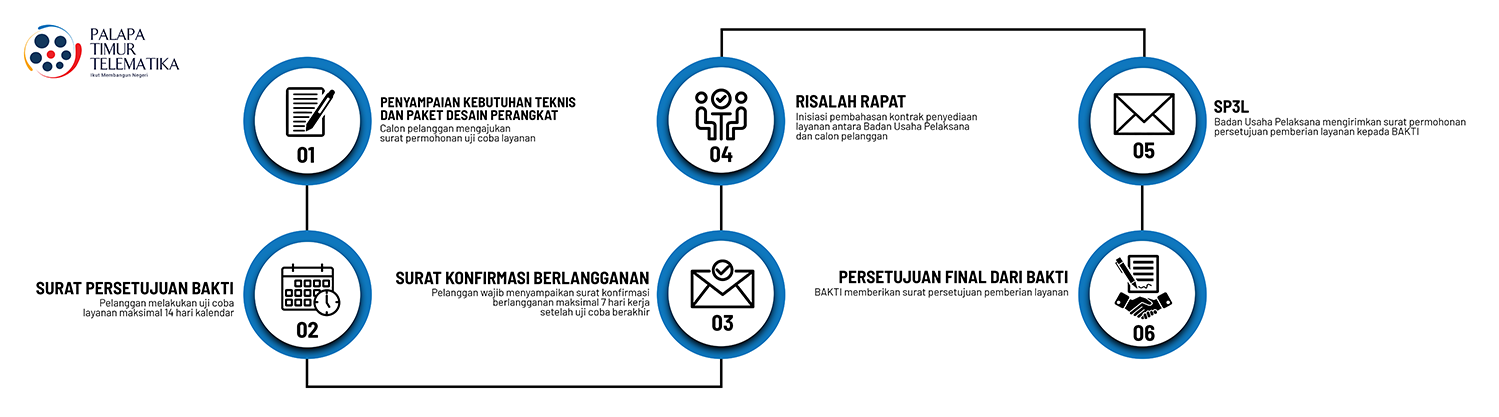
The following are the processes/steps for providing Palapa Ring services to customers:
Service Level Agreement:
SLA is the probability (likelihood) that a Service can be used by a Customer within a one-month usage period. The East Palapa Ring SLA covers 51 districts/cities across 4 provinces: East Nusa Tenggara (NTT), Maluku, Papua, and West Papua, consisting of 35 service districts/cities and 16 interconnection districts/cities.
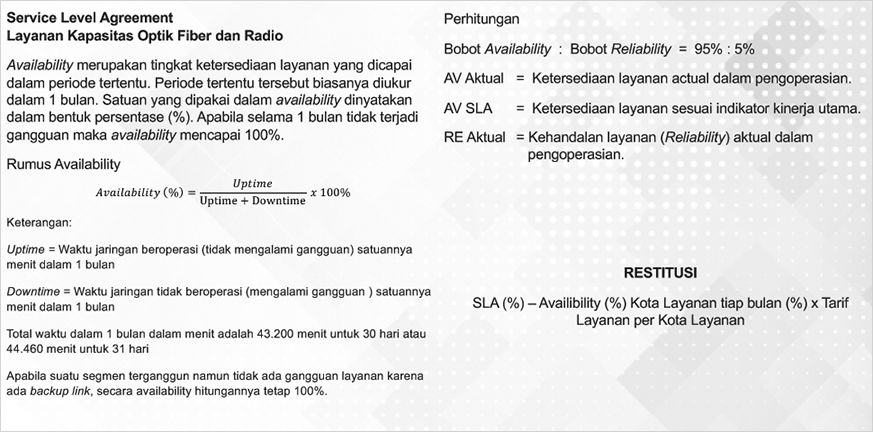
SLA Cities and Link Cities
An SLA City is a city with two links to other cities, each of which is guaranteed by its SLA. If one of the links is broken, customers can only request restitution if the node is completely out of service on all links connected to it. Each SLA City has a different weighting towards the total SLA City in each Project Package. Meanwhile, a Connecting City is a node that is not guaranteed by an SLA if the service cannot be delivered to that node. Customers cannot request restitution if the node is out of service.
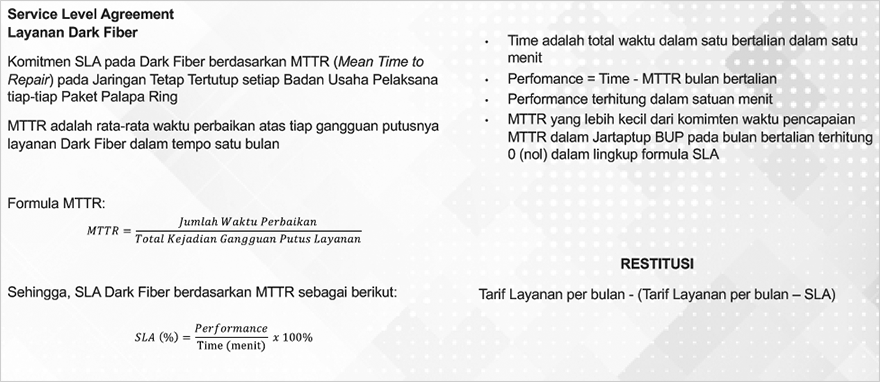
SLA Dark Fiber