News
Freeing Eastern Indonesians from the Internet with Palapa Ring and Satellite
Rote Ndao | June 22, 2018
The Joko Widodo and Jusuf Kalla administration's commitment to ensuring equitable infrastructure development, including telecommunications, will soon be realized in Eastern Indonesia.
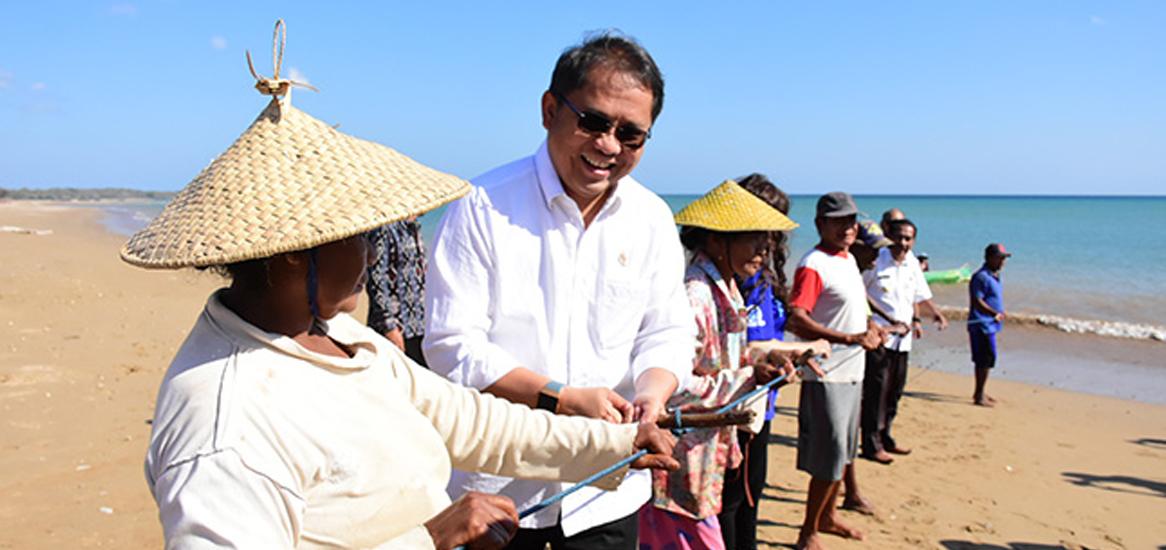
"Speaking of communications, Indonesia has been independent for decades. However, only now is our communication infrastructure being developed, and the government is undertaking large-scale development. Indonesia has been independent from colonial rule for almost 73 years, but we are not yet free from the internet. This means that not all Indonesians can use the internet," explained Minister of Communication and Informatics Rudiantara during a working visit to Rote Tengah District, Rote Ndao Regency, East Nusa Tenggara, Friday (June 22, 2018).
The Minister of Communication and Informatics explained the government's vision of internet independence as an effort to connect all of Indonesia. "I promise, by 2019, this toll road, which you mentioned was built in 2015, connecting Boni Medan with Samurai, must be interconnected. The interconnectedness forms a ring. That's the government's mindset and Mr. Jokowi's vision for liberating Indonesia from the internet," he explained.
Minister Rudiantara not only ensures equal access, but also ensures that people in Eastern Indonesia can enjoy fast internet access like those in Western Indonesia.
"It's not just the slow speed, but the price is higher compared to residents in Java. This is what the Jokowi government believes must be upgraded. Mr. Jokowi is paying close attention to development, including infrastructure, from toll roads to airports and telecommunications," he concluded.
The Minister of Communication and Informatics stated that the government, with its policy of support, will build internet access for all Indonesian citizens. "The government has implemented a policy of support, namely, in non-commercial areas (3T), we are building internet access points, prioritizing education. So far, there are 2,700 internet access points, especially in schools. Of the total 226,000 schools, including junior high and high schools, more than 80,000 are not yet connected," he explained.
To ensure fast internet access, Minister Rudiantara stated that he will use telecommunications satellites with new technology. "We, the Ministry of Communication and Information Technology (Kominfo), together with BAKTI (Indonesian Institute of Technology), are preparing the latest satellite, which is expected to be completed by the end of 2018 or early 2019. It will be launched and operational soon. So, by 2022, all schools should have access to the new satellite, and the speed should be five times faster than the current one," he explained.
The Minister of Communication and Information Technology stated that selecting the education sector as a lever is crucial as part of preparing for the demographic bonus. "You young people will reach a productive age, equal to the economic power of all ASEAN countries. Can you imagine? It will be that big, but that's theoretical and can't happen on its own. It must be supported by internet access in schools, for example," he explained.
Minister Rudiantara emphasized the importance of utilizing high-speed internet access to advance Indonesian education. "Indonesia must have a competitive edge, and the key is strengthening the human resources currently in school. I hope that in the future, there will be no disparities, and that all students in Indonesia will receive what they need, so that not only those with access can develop skills," he said.
The Minister of Communication and Informatics is targeting that by 2020, 20,000 villages currently without internet access will be connected. "So, when you need to report, you won't have to go to the office using paper, but use the internet. This won't just be in Rote Ndao, but across Indonesia," he said.
In addition to high-throughput satellites, which now have orbital slots, Minister Rudiantara explained that the provision of inter-village connectivity is also assisted by the Palapa Ring. The Palapa Ring is built with a 250-kilometer submarine cable network and over 1,000 kilometers of land cables, including microwaves.
"The name Palapa Ring itself aligns with Gajah Mada's promise in his Palapa Oath. The name Palapa embodies the spirit of unifying Indonesia. It will be completed in 2019 and must be operational," he added.
The Ministry of Communication and Informatics is also currently building five BTS towers to ensure public use. "I dedicate these five BTS towers to the people of Rote Ndao. The central government is not requesting funding from the regional budget (APBD), but what I am asking is for the licensing process to be simplified. Please allow the APBD to be managed for the community. I assure you this development will not stop," explained the Minister of Communication and Informatics.
Minister Rudiantara explained that BTS construction is being carried out at certain strategic locations without waiting for the Palapa Ring to be completed. "We have built around 2,700 internet connections to schools since 2015," he explained.
News and image sources:
kominfo